





Electric Range & Charging
2026 Chevrolet Blazer EV Range and Charging
Up to 312 miles on a charge, DC fast-charging that adds about 80 miles in roughly 10 minutes, and an 11.5 kW home charger — here is what the 2026 Blazer EV actually does on the road in Northwest Arkansas.
Range and charge speed move with the battery, the drive layout and the wheels, so this guide reads them trim by trim, then frames them against the drives you make around Rogers and down I-49. Start from the Blazer research hub for the full picture.
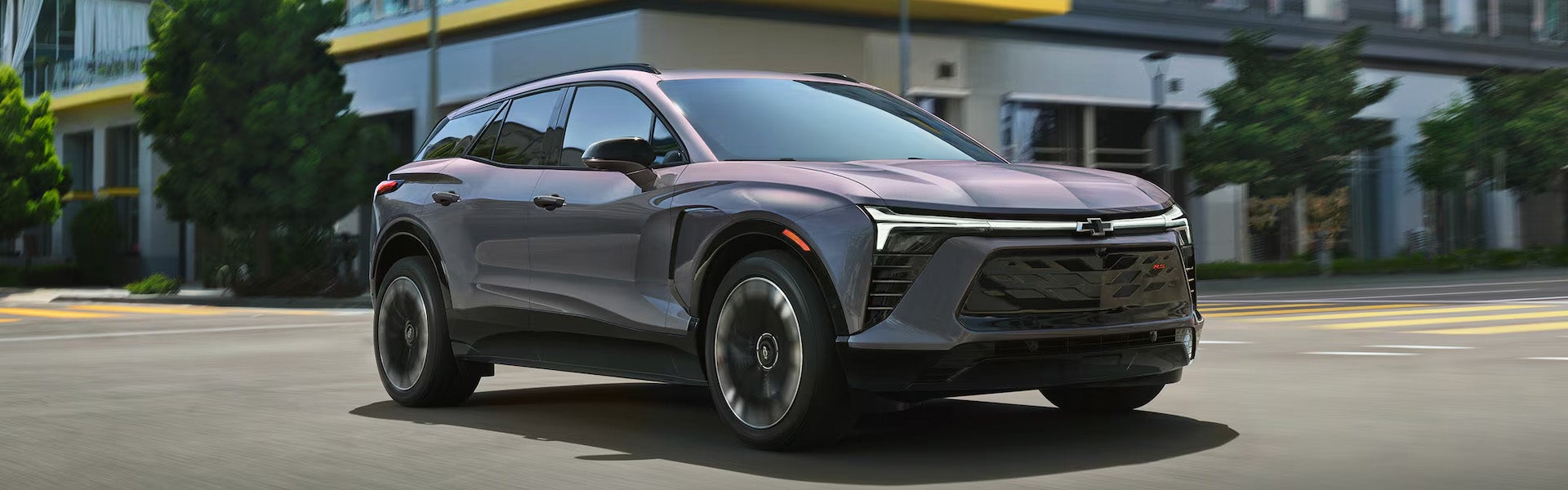
The 2026 Blazer EV is a battery-electric SUV on GM's Ultium platform, and its two questions are always the same: how far does it go, and how long does it take to fill back up. The answers depend on the trim you choose. The LT and RS carry an 85 kWh pack; the SS carries a larger 102 kWh pack. Front-wheel drive is the base drive on the LT and RS, dual-motor eAWD is available on those two and standard on the SS. This is an electric vehicle, so there is no engine and no fuel tank — you charge it, at home overnight or at a public fast charger on a longer day.
Below, the range and efficiency figures come first, then the charge speeds, then the part that matters most: whether those numbers cover the way people actually drive across Northwest Arkansas.
Range
2026 Blazer EV Range by Trim
The top range figure for 2026 is 312 miles, and it belongs to the front-wheel-drive LT and RS on their standard wheels. Move to the 22-inch wheels or to dual-motor eAWD and the rating settles at 283 miles; the performance SS, which is eAWD only and rides on 22-inch wheels, is rated at 302 miles on its bigger battery. Efficiency, stated as MPGe, tracks the same pattern. These are EPA estimates and will vary with speed, temperature and how you drive.
| Trim & drive | Battery | EPA range | MPGe comb |
|---|---|---|---|
| LT / RS, FWD (standard wheels) | 85 kWh | 312 miles | 104 |
| LT / RS, FWD 22-in or eAWD | 85 kWh | 283 miles | 94 |
| SS, eAWD | 102 kWh | 302 miles | 85 |
The takeaway is simple: every 2026 Blazer EV clears roughly 280 miles of rated range, and the front-drive LT and RS reach past 300. The MPGe figures are the electric equivalent of miles per gallon — higher is more efficient — and they are cited from fueleconomy.gov at fueleconomy.gov. Which number you live with is a choice between the reach of the front-drive setup and the traction and power of dual motors.
Charging
How the Blazer EV Charges
There are two ways to add range, and most owners use both. At home you plug into a 240-volt Level 2 circuit through the 11.5 kW onboard charger, which recovers around 51 miles of range per hour — enough to refill a full day's driving while you sleep. On the road you use a DC fast charger, where the 85 kWh pack peaks at 150 kW and the 102 kWh SS peaks at 190 kW; at a fast charger the Blazer EV adds about 80 miles of range in roughly 10 minutes.
| Charging | Power | What it adds |
|---|---|---|
| Home / Level 2 (240V) | 11.5 kW | about 51 miles of range per hour |
| DC fast charge (85 kWh pack) | 150 kW peak | about 80 miles in roughly 10 minutes |
| DC fast charge (102 kWh SS) | 190 kW peak | fastest peak in the lineup |
A word on the plug, because it is changing. For the 2026 model year the Blazer EV uses a native CCS1 charge port, and it reaches Tesla Supercharging stations through GM's NACS-to-CCS adapter. A built-in NACS port arrives on the 2027 model year; the 2026 you buy today charges at CCS1 stations directly and at Tesla's network with the adapter. Either way, the practical daily answer is the garage: plug in at night, leave every morning full.
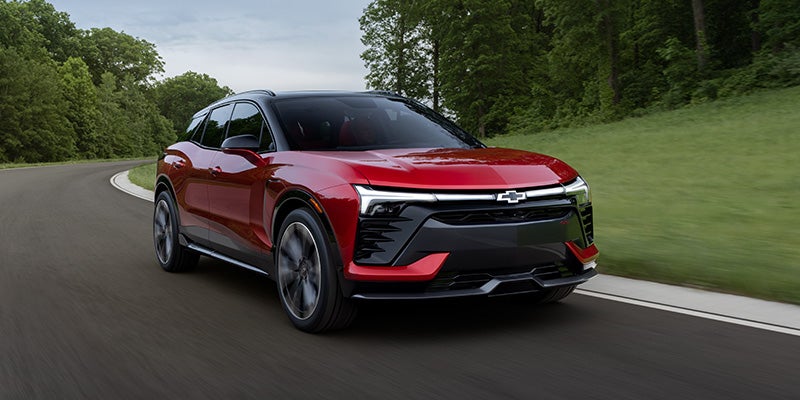
In Practice
What the Range Covers in Northwest Arkansas
Rated range only means something once you set it against the drives you actually make. Most of them here are short. The run from Bentonville down I-49 to Fayetteville is about thirty miles each way; the trip out to XNA to catch a flight is shorter still. A loop of errands that touches Rogers, a school pickup and a stop near the Razorback Regional Greenway rarely breaks fifty miles in a day. Against 283 to 312 miles of range, none of that asks much — you would go the better part of a week between charges, and you never leave home on less than a full battery because it charged overnight.
Weekend distance is where drivers second-guess an EV, and it holds up here too. A day trip across Northwest Arkansas, a drive to the far side of the region and back, a run down to the Boston Mountains — all sit comfortably inside a single charge. The longer haul, a several-hundred-mile interstate drive, is the one where you plan a stop: with the 85 kWh pack pulling 150 kW, that stop is a coffee and about 80 miles back on the clock in ten minutes, not an hour parked. The Blazer EV's range is built for the commuting reality of this region, and its fast-charging covers the occasional long day.
The Decision
Home Charging or Public Charging?
For nearly every Blazer EV owner in Northwest Arkansas, home charging is the routine and public fast-charging is the exception. A Level 2 circuit in the garage puts back roughly 51 miles an hour, so an ordinary day's driving is fully replaced in a few hours overnight and the SUV is topped off by morning. You almost never think about it. Public DC fast-charging is the tool for travel days, when you want a large chunk of range quickly on a route away from home.
The choice between the trims changes the charging math slightly. The front-drive LT and RS go farthest on a charge, so they need the public network least. The SS charges at a higher peak and carries a bigger battery, which suits the longer, faster drives its owner is more likely to take. If your driving is the local mix this region runs on, the range question is settled before you ask it; tell us your commute and your longest regular trip, and we will show you which Blazer EV fits, or walk the trade-offs on the gas vs EV page and the Blazer EV overview.
Questions
2026 Blazer EV Range & Charging FAQs
How far can the 2026 Chevrolet Blazer EV go on a charge?
Up to 312 miles, on the front-wheel-drive LT and RS with the standard wheels. With the 22-inch wheels or dual-motor eAWD the rating is 283 miles, and the SS is rated at 302 miles on its 102 kWh battery. These are EPA estimates and vary with conditions.
How long does it take to charge the Blazer EV?
At home on a 240-volt Level 2 circuit, the 11.5 kW onboard charger adds about 51 miles of range per hour, enough to refill a full day's driving overnight. On a DC fast charger the 85 kWh pack peaks at 150 kW and the SS 102 kWh pack peaks at 190 kW, adding about 80 miles of range in roughly 10 minutes.
What charging port does the 2026 Blazer EV use?
For 2026 the Blazer EV uses a native CCS1 charge port and reaches Tesla Supercharging stations through GM's NACS-to-CCS adapter. A built-in NACS port arrives on the 2027 model year.
Is the range enough for a Northwest Arkansas commute?
Easily. The run from Bentonville down I-49 to Fayetteville is about thirty miles each way and a typical day of local errands rarely breaks fifty miles. Against 283 to 312 miles of range, a Blazer EV goes most of a week between charges, and home charging tops it off overnight.
How big is the Blazer EV battery?
The LT and RS use an 85 kWh usable pack; the SS uses a larger 102 kWh pack. The bigger battery is part of why the SS charges at a higher 190 kW peak and delivers strong range despite its performance eAWD.
Explore the 2026 Chevrolet Blazer Research Hub
Your Next Step
Tell us your commute and your longest regular trip, and we will match you to the 2026 Blazer EV whose range and charging fit how you drive around Northwest Arkansas.
EPA-estimated range and MPGe figures will vary with conditions, speed, temperature and charging. Charge times are approximate and depend on the charger, battery state and temperature.
George Nunnally Chevrolet · 2700 SE Moberly Ln, Bentonville, AR 72712 · (479) 319-2494

May not represent actual vehicle. (Options, colors, trim and body style may vary)
The Manufacturer's Suggested Retail Price excludes tax, title, license, dealer fees and optional equipment. Dealer sets final price.