





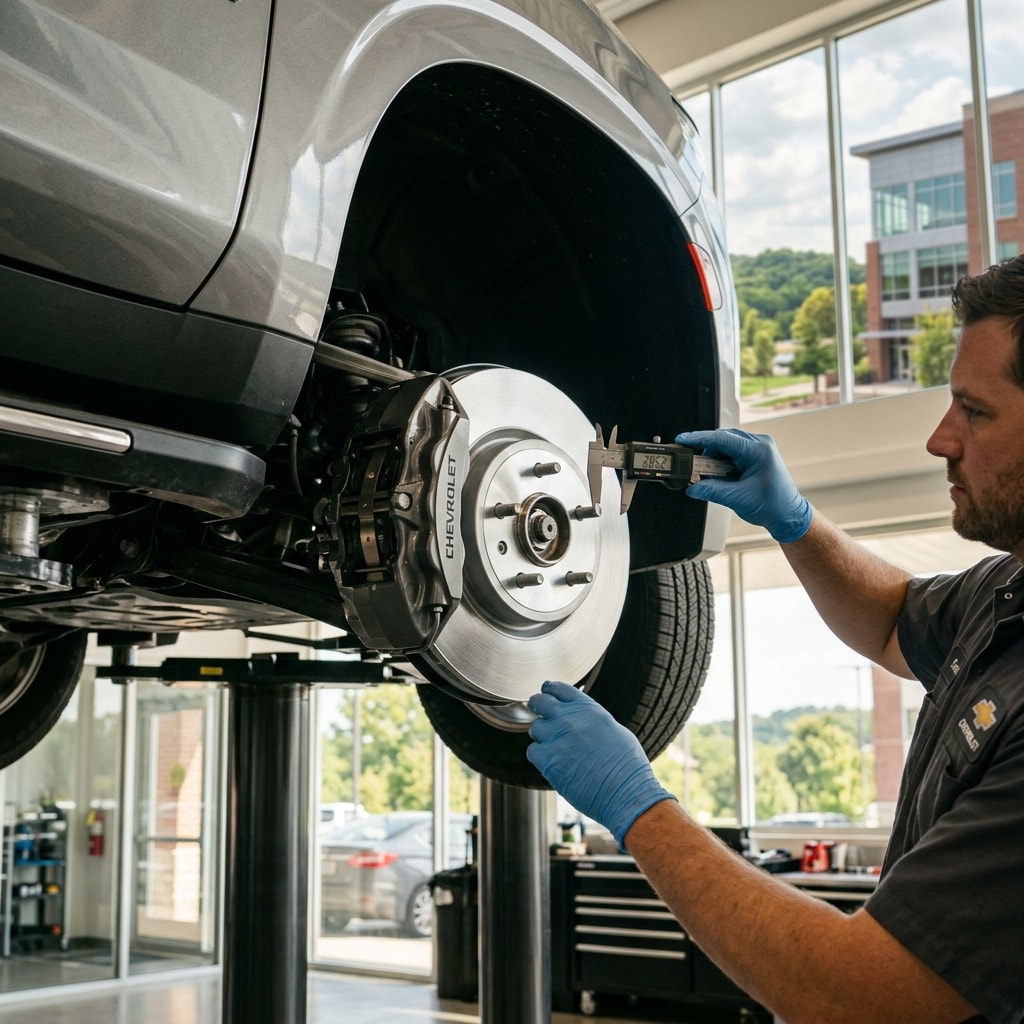
Trusted Performance and Precision Brake Care for Bentonville Drivers
Ensuring your vehicle stops as reliably as it starts is the foundation of automotive safety. At George Nunnally Chevrolet, INC., we specialize in comprehensive certified brake maintenance and repair designed to handle the specific demands of Northwest Arkansas roads. From the stop-and-go traffic near the Walmart Headquarters to the winding descents through the Ozark foothills, your braking system undergoes significant thermal stress. Our team of factory-trained technicians utilizes advanced diagnostic tools to measure pad thickness, inspect rotor integrity, and verify that your hydraulic system is free of moisture or air gaps.
Maintaining peak stopping power requires more than just a quick visual check. We perform a detailed multi-point inspection during every visit to identify potential issues before they become costly repairs. This proactive approach is a core part of our Nunnally Buyer’s Advantage Program, which provides our customers with a free 3-year maintenance plan including tire rotations and thorough system checks. If you have noticed a change in how your pedal feels or hear an unusual sound when slowing down, you can easily book a service appointment online to have our experts take a look.
Transparency and community-focused service ensure every driver understands the condition of their vehicle. Whether you are commuting daily or preparing for a weekend trip to Crystal Bridges Museum of American Art, our facility is equipped to keep your vehicle performing at its best. For those who prefer to speak with a service advisor directly, feel free to give us (479) 319-2494 for a quick consultation. If you are ready to visit us in person, you can find our service center location right here in Bentonville.
Table of Contents
- Recognizing Critical Signs Your Braking System Needs Immediate Attention
- Dealership Expertise vs Independent Repair Shops for Modern Safety Systems
- Specialized Maintenance for Electric Vehicles and Regenerative Braking
- Essential Parts Quality and Warranty Protection for Long Term Reliability
- Common Brake Questions and Ownership Best Practices
Recognizing Critical Signs Your Braking System Needs Immediate Attention
How do you know when your vehicle is trying to tell you something is wrong? Many drivers first notice a high-pitched squealing noise, which is often caused by a small metal shim called a wear indicator. This part is designed to make noise once your brake pads have reached a specific level of depletion, usually around 2 millimeters of remaining material. Ignoring this sound can lead to a grinding sensation, indicating that the friction material is completely gone and the metal backing plate is now damaging the rotor surface. This “metal-on-metal” contact significantly increases stopping distances and repair costs.
Another common symptom is a pulsating sensation through the steering wheel or brake pedal during deceleration. This often points to warped rotors or uneven pad deposits, which can occur during heavy towing in a heavy-duty truck or after frequent hard braking in hilly terrain. If the vehicle pulls to one side when you apply the brakes, it could indicate a stuck caliper or a collapsed brake hose. Furthermore, a “spongy” or soft pedal usually suggests air in the lines or a problem with the master cylinder, both of which require immediate professional intervention to prevent total system failure.
Safety remains the highest priority for families navigating the busy school zones in Rogers. Modern safety suites, such as those found in the versatile Trax, rely on the mechanical health of the braking system to function correctly. Features like Automatic Emergency Braking and Front Pedestrian Braking cannot perform their jobs if the physical hardware is compromised. Even the nimble midsize Colorado requires healthy rotors and fresh fluid to maintain the agility needed for both city driving and off-road excursions. A professional inspection is recommended at the first sign of any vibration, noise, or change in pedal pressure.
Dealership Expertise vs Independent Repair Shops for Modern Safety Systems
Is there a significant difference between a local general mechanic and a specialized dealership service center? While independent shops offer general repairs, our technicians receive ongoing, specialized training specifically for 2026 models and their complex electronic architectures. Modern vehicles integrate the braking system with the Electronic Stability Control and Traction Control modules. Calibrating these systems requires proprietary software that general shops may not possess. When we perform a repair, we ensure that every sensor and computer module is communicating correctly, maintaining the factory safety standards of your vehicle.
The quality of components used during a repair is another critical factor in long-term reliability. We use genuine OEM parts that are engineered to the exact specifications of your vehicle’s weight and performance capabilities. For example, the high-performance braking requirements of a Silverado 3500HD are vastly different from the 11-inch rotors found on some compact SUVs. Using the wrong pad compound can lead to excessive dust, increased noise, and premature rotor wear. To ensure you have access to the right components for your specific model, you can request authentic Chevy parts directly through our department.
As automotive technology shifts toward electrification, the gap in expertise becomes even more apparent. Specialized vehicles like the all-electric Blazer EV utilize sophisticated braking systems that require high-voltage safety training to service. Our facility is invested in the specialized tools and diagnostic equipment necessary to handle these advanced platforms. By choosing a certified service center, you are ensuring that your vehicle is handled by professionals who understand the nuances of its specific engineering, rather than a generalist who may be seeing the technology for the first time.
Specialized Maintenance for Electric Vehicles and Regenerative Braking
Does an electric vehicle actually need brake service if it uses motors to slow down? This is a question we hear frequently as more drivers in Springdale transition to electric mobility. EVs use Regenerative Braking, a process where the electric motor reverses to capture kinetic energy and recharge the battery. This significantly reduces the physical wear on the traditional friction brakes—pads and rotors—allowing them to last much longer than those on a standard internal combustion vehicle. However, this lack of frequent use can actually lead to its own set of issues, such as surface rust on rotors or caliper slides seizing due to inactivity.
Periodic maintenance is essential to ensure the mechanical backup system is ready when you need it most. We perform “brake cleaning and lubrication” services specifically for EVs to keep the hardware moving freely. This is particularly important for those who have recently moved into well-maintained one-owner vehicles and want to preserve that reliability. Even in large EVs like the spacious Suburban (in its traditional or electrified variants), the brake fluid remains a hygroscopic liquid, meaning it absorbs moisture over time. This moisture can cause internal corrosion and should be flushed according to the manufacturer’s recommended intervals.
The driving experience in a modern SUV, such as the stylish Blazer, is enhanced by these quiet and efficient systems. However, the added weight of EV battery packs means that when the friction brakes are called upon during an emergency stop, they must perform under higher loads. Our technicians check for consistent pad wear and test the boiling point of your brake fluid to ensure it can handle the heat of a sudden stop. Proper EV brake care isn’t just about replacing worn parts; it’s about maintaining a system that spends most of its time waiting in reserve.
Essential Parts Quality and Warranty Protection for Long Term Reliability
When you invest in a brake repair, you are paying for the peace of mind that comes with a guaranteed result. Repairs performed at George Nunnally Chevrolet, INC. come with a standard warranty of 12 months or 12,000 miles, providing protection against defects in materials or workmanship. This coverage is a stark contrast to many “budget” brake jobs that use white-label parts with no nationwide backing. If a component fails within the warranty period, you can visit any authorized dealer to have it addressed, which is a major advantage for families who travel frequently.
Our dedicated parts and service team prioritizes the use of original equipment because it eliminates the guesswork of aftermarket compatibility. For heavy-duty applications, such as a new Tahoe used for family hauling, the friction material must be able to dissipate heat effectively to prevent “brake fade” during long descents. We also offer specialized hardware kits for the capable Colorado that include new clips and springs, ensuring the pads retract properly and don’t drag against the rotor. This attention to detail extends the life of your tires and improves your overall fuel efficiency.
- Genuine OEM Pads: Designed for specific noise, vibration, and harshness (NVH) standards.
- Precision Rotors: Cast with high-carbon iron for maximum heat resistance and durability.
- Certified Fluid: Formulated to protect against internal seal degradation and corrosion.
- Expert Labor: Performed by technicians who specialize in your vehicle’s specific platform.
Common Brake Questions and Ownership Best Practices
One of the most frequent questions we receive involves the timing of brake replacements. On average, brake pads last between 30,000 and 70,000 miles, but this range varies wildly based on your driving habits. A driver frequently navigating the morning rush on I-49 will likely need service sooner than someone who primarily drives on open highways. We recommend having your brakes checked during every oil change—a service included in our free maintenance plan—to track the wear rate of your specific vehicle.
For those driving larger family vehicles like the three-row Traverse, we often suggest checking the rear brakes just as often as the front. While the front brakes typically do about 70 percent of the work, many modern vehicles use the rear brakes for stability control and electronic parking brake functions, which can lead to faster-than-expected wear in the back. If you are unsure about the current state of your stopping power, you can reach our advisors at (479) 319-2494 to discuss your symptoms.
Our commitment to the community means providing honest advice that fits your lifestyle and budget. Whether you are coming from Rogers or right here in town, we strive to make every visit efficient and transparent. If you are ready to experience the Nunnally difference, you can get easy directions to our Bentonville facility and meet with our service team. We are here to ensure your vehicle remains a safe and reliable partner for all your Northwest Arkansas adventures.
Quick Answers Regarding Your Vehicle’s Brakes
Q: Should I resurface my rotors every time I change my brake pads?
Rotors do not always need to be replaced, but they should be measured for thickness and inspected for “runout” or warping. If the rotor is above the minimum safety thickness and has no deep scoring, resurfacing can provide a smooth mating surface for new pads. However, if they are thin or heavily damaged, replacement is the only safe option to ensure proper heat dissipation.
Q: Why does my brake pedal feel soft or travel further than usual?
A “low” or soft pedal often indicates a leak in the hydraulic system or air bubbles trapped in the brake lines. It could also be a sign of a failing master cylinder or severely worn brake pads. Because this condition directly impacts your ability to stop in an emergency, it should be inspected by a certified technician immediately to prevent a total loss of braking pressure.
Q: Is it normal for my brakes to make a grinding noise in the morning?
If your vehicle has been sitting overnight or in humid conditions, a thin layer of surface oxidation (rust) can form on the iron rotors. This often causes a slight grinding or swishing sound during the first few stops of the day as the pads “sweep” the rotors clean. If the noise persists after a few minutes of driving, it likely indicates worn-out pads and requires professional attention.
Q: How long does a standard brake pad replacement take?
For most modern cars and SUVs, a standard pad replacement on one axle typically takes between one and two hours. This timeframe includes a thorough inspection of the calipers, rotors, and fluid lines. If the rotors need to be resurfaced or if the hydraulic system requires a flush, the total time may increase slightly, but we strive to get you back on the road as quickly as possible.
Q: Does Chevrolet Roadside Assistance cover brake-related issues?
If your brakes fail or the warning light indicates it is unsafe to drive, Chevrolet Roadside Assistance: 1-800-243-8872 can coordinate a tow to the nearest authorized service center. This service is often included with your vehicle’s warranty and ensures that your car is handled by professionals who use genuine parts. Our team can work with you to manage the repair once the vehicle arrives at our facility.
Schedule Your Next Brake Inspection Today
Don’t wait for a warning light to prioritize your family’s safety on the road. Whether you have noticed a slight squeak or simply haven’t had your system checked in a while, our team is ready to provide the expert care you deserve. You can schedule your service appointment online in just a few clicks to find a time that fits your busy schedule. We look forward to helping you maintain the performance and reliability of your vehicle for years to come.
Connect with us


- Auto Repair Fayetteville
- Bentonville Chevrolet Dealer
- Bentonville Chevrolet Service
- Bentonville Oil Change
- Bentonville Used Cars
- Car and Auto Repair Service
- Chevrolet Silverado 3500HD
- Chevy Colorado
- Chevy Corvette
- Chevy Super Cruise Hands Free Driving
- Chevy SUVs
- Chevy Trucks
- Corp Business Vehicles
- Electric SUVs
- Fayetteville Chevy Dealer
- Fayetteville Used Car Dealer
- Fleet Vehicles Bentonville
- Fleet Vehicles Fayetteville
- Fleet Vehicles Rogers
- Fleet Vehicles Siloam
- Fleet Vehicles Springdale
- George Nunnally Chevrolet Service
- Mechanic
- Mid-Sized Truck
- Model Comparisons
- Model Lineup Analysis
- No Credit Bad Credit Financing
- NWA Chevrolet Dealership
- NWA Chevy Dealer
- Off-Road Truck
- Rogers Auto Repair
- Rogers Chevrolet
- Rogers Chevrolet Dealership
- Rogers Chevrolet Service
- Rogers Oil Change
- Rogers Used Car Dealership
- Siloam Chevrolet Dealership
- Silverado 1500
- Silverado 2500
- Silverado 3500HD Dually
- Silverado EV
- Silverado Trucks
- Springdale Auto Repair
- Springdale Brake Repair
- Springdale Chevrolet Service
- Springdale Chevy Dealer
- Springdale Chevy Service
- Springdale Used Car Dealer
- Springdale Used Car Dealership
- Tire Rotation Fayetteville
- Trade Value
- Uncategorized
- Used SUV Dealership
- Work Trucks